
Scene on the Sound
By the Captain (Royal Navy retired), The Beagle's maritime correspondent
September 25 2026
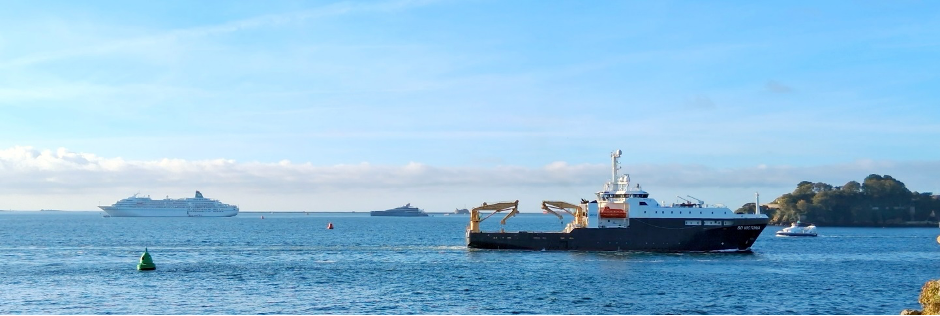
Another busy on and around The Sound. The German Air Defence Ship, FGS Hessen, went out to sea on Monday morning and returned the same afternoon. Her RN equivalent, HMS Dauntless has been out in the areas training for most of the week and returned to Devonport on Thursday afternoon. In addition, two of the RN’s Type 23, Duke-class, frigates have been around, HMShips Sutherland and Portland.
The last of this year’s cruise ships, the 29,000-ton German MV Amadea was in the Sound on Thursday – for a slightly shorter visit than usual – she sailed in the early afternoon. Amadea is on a 26-day cruise from Hamburg, calling at Portsmouth and Plymouth en route the Azores and then returning via the Portuguese and Spanish coasts with a port visit to Guernsey before Hamburg.
The SY Aviva has returned to her ‘home port’ of Plymouth Sound after a couple of days up-Channel and the, slightly mysterious, SD Victoria returned here on Thursday morning. I say ‘slightly mysterious,’ because I have no idea exactly what SD Victoria does. She is described as a ‘Worldwide Support Vessel,’ which could mean almost anything. She is equipped with accommodation for 72 troops, classrooms, briefing and operations rooms, in addition to workshops. She can also carry RIBs and has a helicopter winching facility, as well as two large davits aft. SD Victoria is clearly very versatile and very capable.
No doubt, she is being well used as the North Atlantic and surrounding areas become tenser and the Russians become more aggressive in their probing of NATO’s defences.
WORLDSTAR 2026 postponed
WorldStar 2026, organised by the Royal Western Yacht Club, was due to start from Plymouth on Saturday (26 September) at midday. The race would have been a non-stop, unassisted solo or double-handed circumnavigation of the World, leaving Antarctica to starboard. However the Club has announced that the start of the Race has been postponed indefinitely because of the hostilities in the Red Sea and the Gulf, which have already spread into the Arabian Sea, the top part of the Indian Ocean.
Princess Yachts Returns to Profit
Local luxury yacht manufacturer, Princess Yachts, was sold by the French luxury conglomerate Louis Vuitton Moët Hennesy, to a New York based private equity firm, KPS Capital Partners. Subsequently, there has been a thorough review of how Princess yachts operates and the results are now beginning to show.
Despite the tough conditions in the worldwide luxury yacht market, Princess Yachts made an operating profit of £17.6m to the year ended 31 Dec 25, compared with an operating loss of £8.1m in the previous year. So, we hope that another on Plymouth’s maritime businesses will continue to flourish. The firm's latest yachts are the F58 and V65. Watch out for them being tested on the Sound.
Another step forward for Plymouth's marine robotics pioneers at ACUA
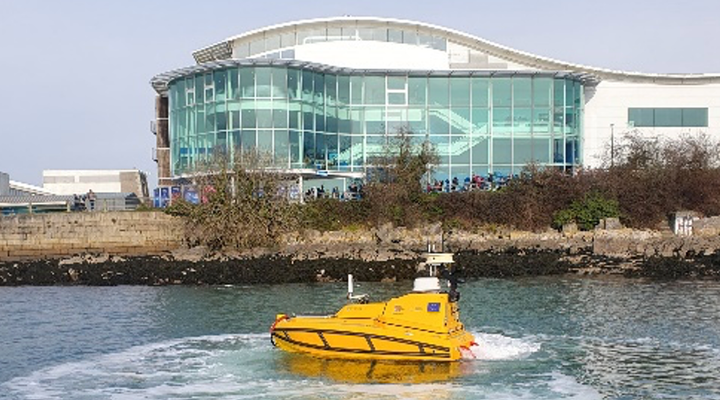
Your Captain was lucky enough to be invited to view a new trial by ACUA, the Turnchapel based USV company: the use of an ROV (Remotely Operated Vehicle) from their Pioneer. This trial was designed to prove that an ROV could be operated remotely from an unmanned platform.
The trial was funded jointly by the European and UK Space Agencies and the ROV, an Argos[1], came from a French company Forssea Robotics, based in Sète, in the south of France. The audience for the pre-trial presentations was multi-national (with representatives from the UK, France, Norway, Portugal and Qatar) as well as multi-disciplinary (hydrographers, military, subsea engineers etc.).
The Forssea spokesman was very complimentary about how easy it had been to integrate their ROV with ACUA’s Pioneer. Basically, the joint team had had to manufacture a launch beam that could lower the Argos safely into the water, then release it to do its task. The Argos is a tethered ROV – in other words, the winch onboard Pioneer has to pay out the Argos’s control cable as necessary and, of course, recover it too. As the mariners amongst our readers will realise, when operating an ROV near the bottom or around something like a wind turbine base, the last thing you need is a bight of loose cable than can catch on things, because if it can, it will. In many ways, the most difficult part of the trial was ‘catching’ the ROV at the end of its task.
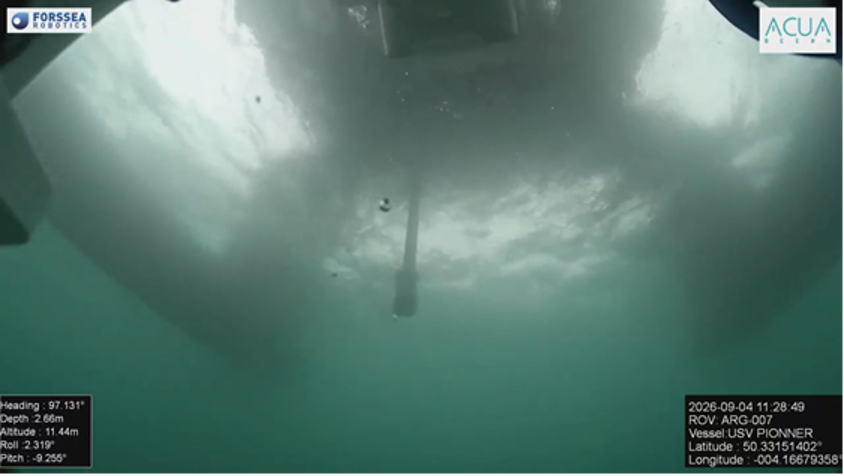
The demonstration of Pioneer and Argos working remotely together took place off the western end of the breakwater. The sea was about state 3-4 – quite uncomfortable in Plymouth Boat Trip’s Legend of Plymouth, from where the observers were watching. During the shore presentations, a point had been made about how little Pioneer moves in a seaway, comparted to a monohull, like Legend of Plymouth. The conditions off the end of the breakwater proved this to everyone’s satisfaction, so the demonstration of the release and recovery of the ROV was conducted with Legend of Plymouth observing from the, slightly calmer, Cawsand Bay. Throughout, the ROV’s camera view of the underside of Pioneer and sea bottom was being relayed to a laptop onboard Legend, but obviously this laptop and the controls for both Pioneer and Argos could have been anywhere in the world.
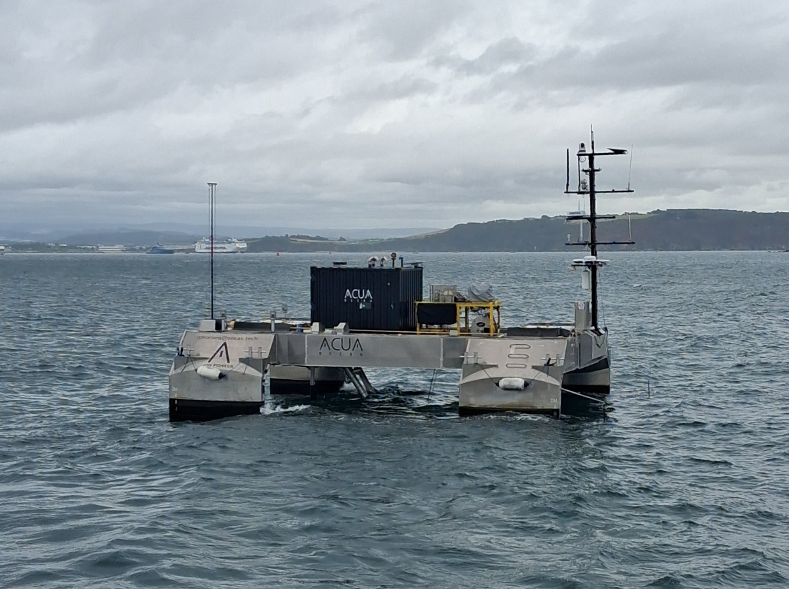
This trial was another demonstration of the vast range of skills here in Plymouth, as the United Kingdom’s widely recognised centre of excellence in marine robotics.
[1] Once the integration process of Forssea’s ROV with a USV is completed, that ROV will be designated the Argos-X
Comments ()