
Sad Christmas as icon of the Barbican sets out its last festive display

Plus The Captain explains about warships, and a step forward for the Civic Centre. It's your Beagle from Plymouth Hoe on Thursday November 20
Last Christmas - it's the end of an era for Barbican icon
After lighting up Christmas in the Barbican area for three decades, Plymouth Glass Gallery has just set out its final Christmas display.
Owners Ian and Liz Nicholls are retiring and closing their shop in Southside Street in the new year.




It brings an end to a 30-year era, and it’s left some regular customers from far-and-wide devastated.
Irish, French, Scottish and Dutch accents are frequently heard in the landmark store, one of the largest in the Barbican (a restaurant used to occupy the premises).
“It feels strange, and a little bit sad,” said Liz. “We’ve had so many lovely messages saying how sorry people are to hear we are closing.”
The Christmas tradition started in the first year Plymouth Glass Gallery moved to its current shop from the nearby Parade.
“We moved here towards the end of the year, 14 years ago, and I just decided we’ll do a big Christmas display and announce to the street and to the Barbican that we are here. And we couldn’t believe it - it was like opening floodgates. And so it became an annual thing,” said Ian.
Planning for this year’s final display began last Spring and it’s already made an impact - with shoppers packed inside shoulder-to-shoulder last weekend.
Customers had been asking since May about what the display will be, and when it would be revealed.
So it’s a bitter sweet time for the couple, who also used to run a glass gallery in Dartmouth.
For artist Ian, who makes much of the glass on sale, it won’t be a full retirement just yet. Plymouth Glass Gallery will continue online, taking commissions and selling products.
“I’ve got a new workshop at a farm so I’ll still be making,” he said. “But definitely on a smaller scale.”
Plymouth Glass Gallery, 23 Southside Street, Barbican, is open Wednesday to Sunday, from 11am to 4pm, and is online at plymouthglassgallery.com
What type of warship is that?, by The Captain
My loyal readers (well, I think there are some…) will know that I have promised to explain the different ways warship types are named. What are destroyers compared to frigates or corvettes or even offshore patrol vessels (OPVs)?
Well – to go back to the Nelsonic era, there were battleships, frigates and other minor war vessels (MWVs – lots of potential acronyms!). Battleships were those leviathans of the fleet – like HMS Victory that were capable of fighting their equals in the ‘line of battle’.
They were rated by the number of guns:
First Rate: 100+ guns on three decks. 2000+ tons & 850+ crew
Second Rate: 90+ guns on three decks. Approx. 2000 tons and 700-750 crew
Third Rate: 64-80 guns on two decks. Approx. 1750 tons and 650 crew
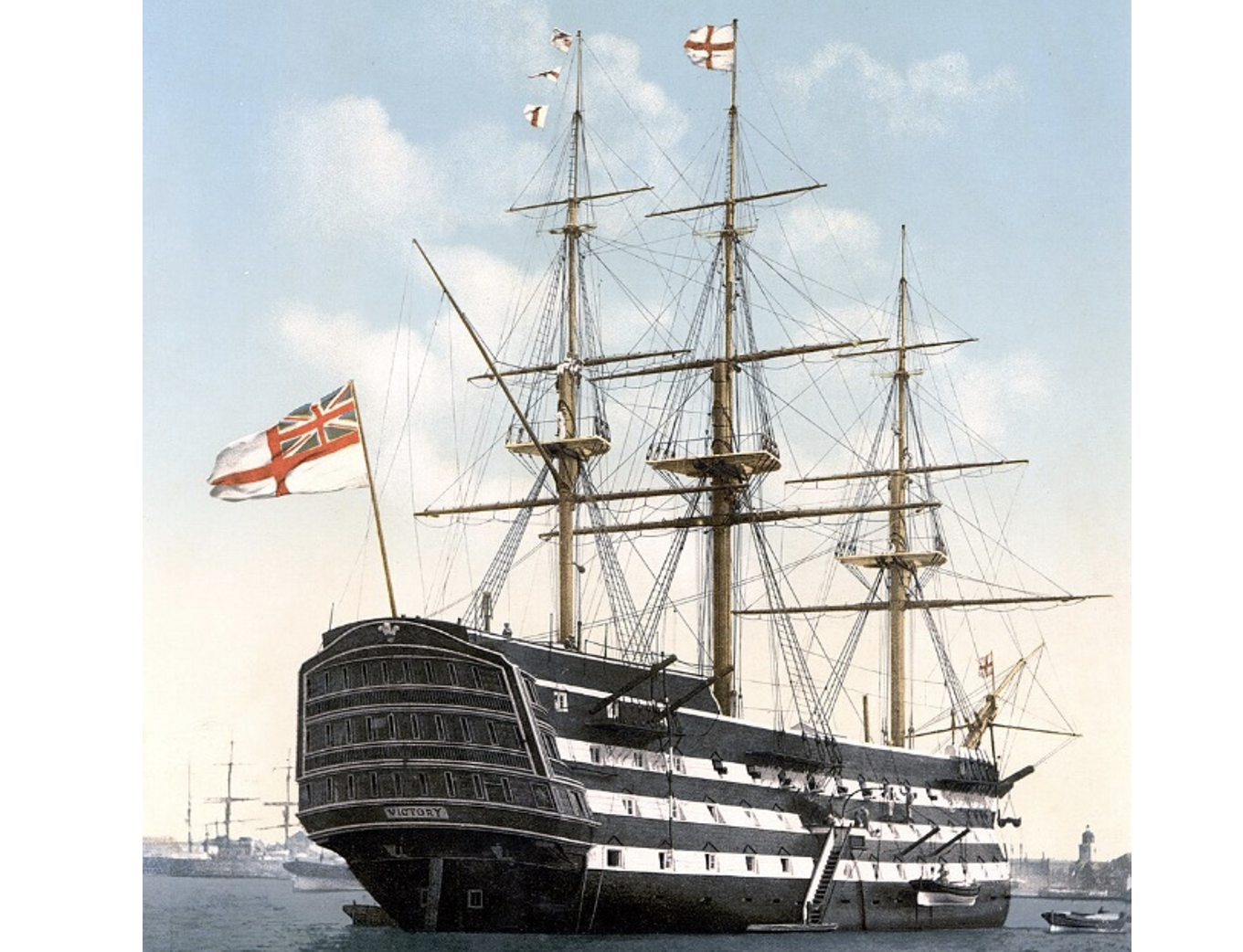
Smaller sailing warships were known as Fourth, Fifth and Sixth Rates. They were not powerful enough to join the line of battle. Fourth Rates were often used in distant waters. The famous frigates of Cochrane, a real ‘swashbuckling’ frigate captain and the fictional Hornblower and Aubrey were Fifth Rates with 32-40 guns and a crew of 300. Sixth Rates were minor war vessels in today’s terms – see corvettes below.
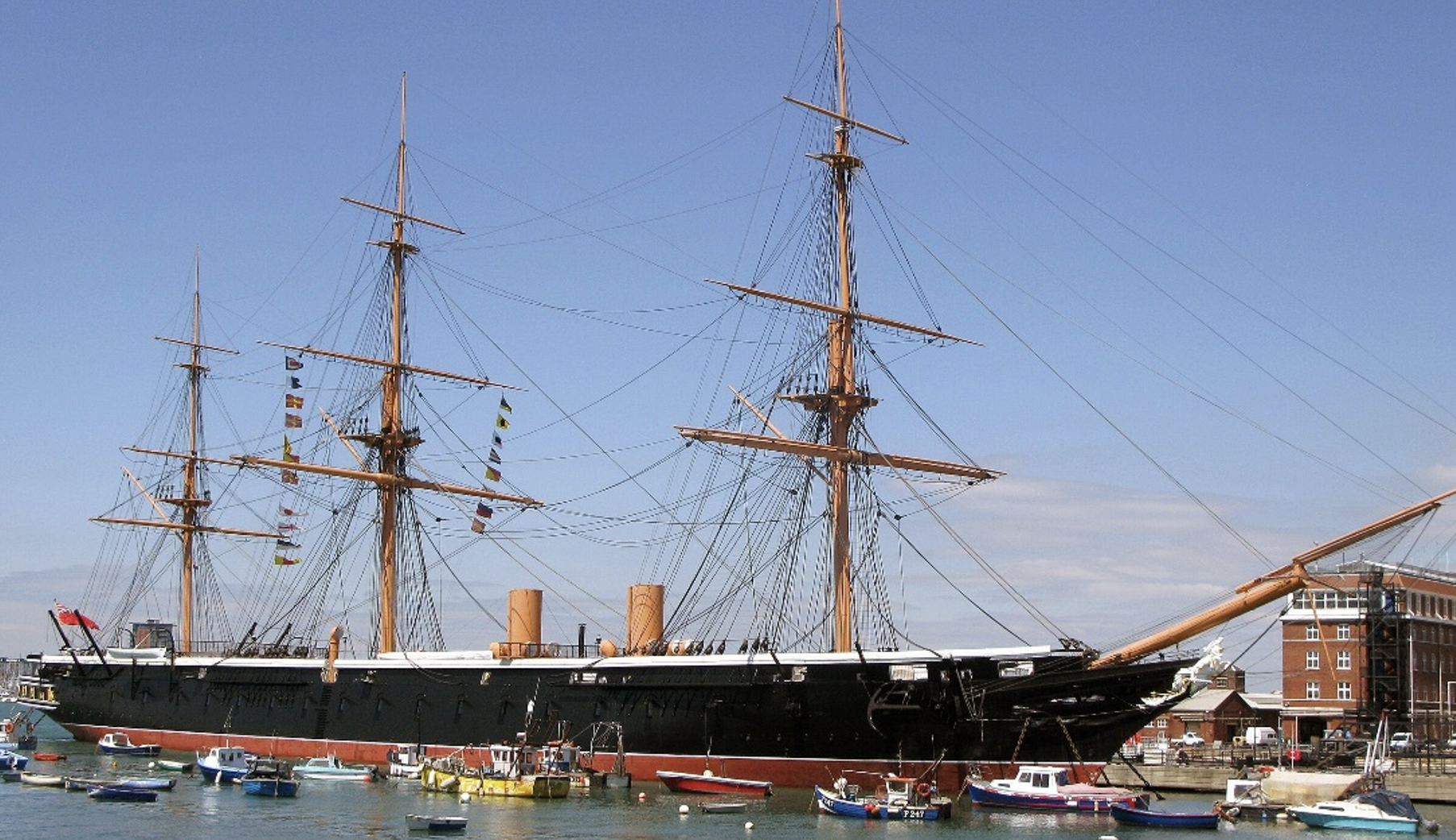
The sailing navies were superseded, initially, by ironclad wooden ships & then rapidly by steel ships. The French were first to have an ironclad warship at sea – the FS Gloire in 1859 She was rapidly outclassed by HMS Warrior in 1860, which is still afloat in Portsmouth. Warrior was classed as an ‘armoured frigate’ – they were clearly using the old Rate designations as he had only 40 guns, but displaced 9000 tons!
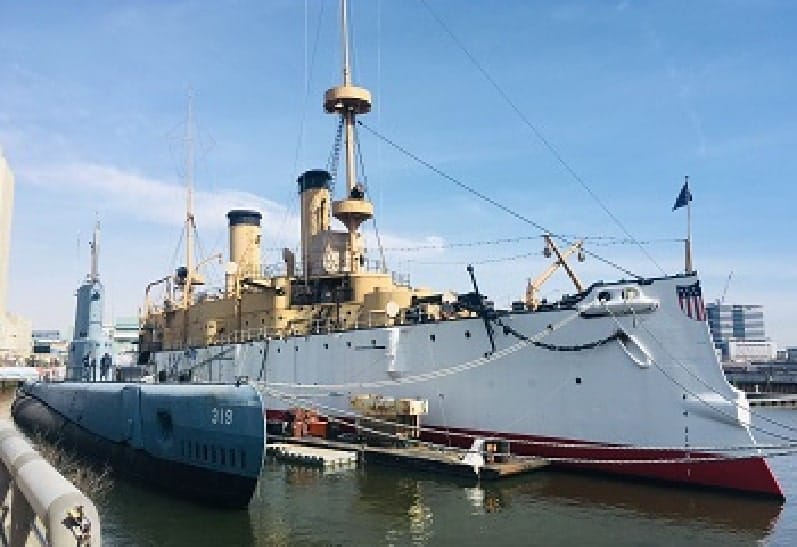
The oldest steel warship still afloat is the 1895 USS Olympia, is presently part of a museum in Philadelphia. She displaced 6000 tons and was rated as an ‘armoured cruiser’. Clearly there was little agreement on what to call warships at the beginning of the modern warship era.
The first modern battleship burst onto the scene in 1906 – HMS Dreadnought. For many years thereafter, a navy’s capital (i.e. ‘first rate’ and probably flagships ) ships were called Dreadnoughts, or in due course, super-Dreadnoughts. Today’s capital ships are the big aircraft carriers. HMS Dreadnought revolutionised naval warfare in that she was fast (for the time – 21 knots), displaced 21000 tons, was heavily armoured and had 10 12” guns in five armoured turrets. She could easily overpower every other warship in the world.
So, by WWII, Navy’s gun-armed ships were called battleships, cruisers and destroyers. Cruisers were sub-divided into heavy, with 8” guns and light, with 6” guns. The destroyer came about as a defence against the torpedo boat (a lightly armed, fast craft carrying one or more torpedoes). The name frigate had gone out of use. Until… during WWII there arose an urgent need for less capable destroyer-like ships to be used as convoy escorts. The larger ones were called frigates and the smaller ones corvettes (originally a French naval term). So, destroyers became the fast, heavily-armed fleet escorts & the more lightly armed escorts were frigates or corvettes.
Today, different navies pick and choose their type designation. In the Royal Navy, ships with force or area air defence role are called destroyers and anti-submarine ones are called frigates. It is said that this distinction came about because at the start of the missile age, the RN bid for a new class of cruisers – missile armed ships of the same tonnage as older light cruisers. The Treasury vetoed the proposal and so the year after, the RN came back with a big for a new class of destroyers – exactly the same ships, just redesignated. So, the 6500-ton County class destroyers were commissioned. Their successors were the Type 42s, of the Falklands War, at 5350 tons and now the Type 45s (HMS Dragon is presently around here) at 8500 tons. For comparison, a WWII heavy cruiser displaced 10,000 tons. The relentless growth of warships is dictated by the desire to carry more and more weapons – it is said that the Type 45s may be replaced by a 10000-ton air defence ship
In comparison, the RN’s modern frigates (the Type 23 Duke class) displace 4900 tons and their successors, the Type 26 (City class ) will displace 8000 tons – not significantly smaller than the Type 45s. and to go back 60 years – the Blackwood-class of ‘second-rate’ Anti-Submarine Warfare (ASW) frigates – built as an early Cold War escort, displaced 1500 tons – 500 tons less than today’s River-class OPVs.
Truly, there is no uniformity in ship designations these days! The French Navy uses the same categories as the RN, but the Royal Netherlands and the Federal German Navies call their escorts, regardless of role, frigates. The US Navy still has cruisers (their larger air defence ships), destroyers (smaller air defence ships) and Frigates (ASW escorts). So, to recap, warship designations are now decided by national preference and tradition, role and, to an extent, size and displacement. NATO has a standardisation agency, but this is one area where they have not succeeded.
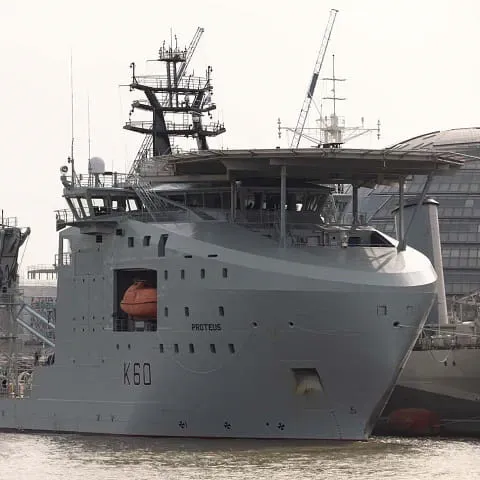
Weird visitor is a pioneer of the seas.
If you were ship-gazing today (Thursday) you might have been forgiven for wondering: “What is that?!”
RFA Proteus was in the Sound. She is the first of a new generation of survey and surveillance ships harnessing leading-edge technology dedicated to monitoring what goes on underwater in areas of UK sovereign interest.
Proteus acts as the launchpad for remotely-operated vehicles and a suite of specialist capabilities similar to those found in the oil and gas industries monitoring waters vital to UK interest.

Duke of Cornwall’s backside plan
It’s looked a sorry state for some time. But plans are afoot to restore the rear of the Duke of Cornwall hotel.
A “pre-planning application” has been submitted and dealt with by Plymouth Council.
The metal fire escapes will also be replaced as part of the work.

Funding deal signed to progress Civic Centre regeneration
The biggest piece of the funding jigsaw needed to regenerate the Civic Centre is now in place with the signing of a significant funding agreement.
Homes England – the government’s housing and regeneration agency – has signed the grant funding agreement with Plymouth Council for £18.4 million. It’s the largest piece of funding for the £47.5 million project to create 144 apartments and a City College Plymouth campus in the iconic post-war building which was once council offices, and which was opened by the late Queen Elizabeth in 1962.
The deal heralds the start of an intense period of activity ahead of a refreshed planning application being submitted and people can comment, get involved and share stories about this city landmark.
For more information visit : https://plymouthciviccentre.commonplace.is/
Advertisement:


Comments ()