
Jet Pig, Yellow pig, and On the Buses!

It's The Beagle on Friday August 14, 2026
Pigs and identifying the various unmanned "autonomous" vessels in The Sound
By The Captain, Beagle maritime correspondent
The University of Plymouth runs an Unmanned Surface Vehicle (USV) programme from Coxside, with objectives of teaching and carrying out research into USVs. The School of Biological and Marine Sciences is also involved in delivering accredited courses, training and data acquisition for commercial clients.
You may spot the following USVs out on the Sound – from the smallest upwards:

Jet Pig was designed and built by the university's marine station at Coxside. She is 1.5 m long and was built to operate in energetic surf. She is self-righting and can be used to survey beaches both before and after major storms, including tsunami. Jet Pig’s top speed is 12 knots and she has an endurance of 90 minutes at five knots.
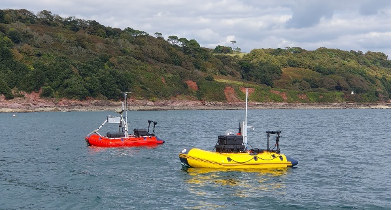
The Yellow Pig – a 2.3m inflatable (just like a yacht’s tender) built about five years ago for £1500. She can run for about six hours at three knots and is the university's most frequently used USV. Yellow Pig can be transported to site in a 6m RIB (Rigid Inflatable Boat) and is used for tasks such as seagrass and hydrographic surveys, for which she is fitted with a multi-beam echo sounder. She is a very stable and capable platform and has been used regularly in repeat surveys.
Red Pig (slightly bigger than her yellow sister at 2.5m) is also one knot faster, with an on-task endurance of six hours at four knots. She has much the same role as Yellow Pig. Her software package (control and hydrographic acquisition) was written in-house by the university survey team, and she can be operated beyond line-of-sight (but isn’t).
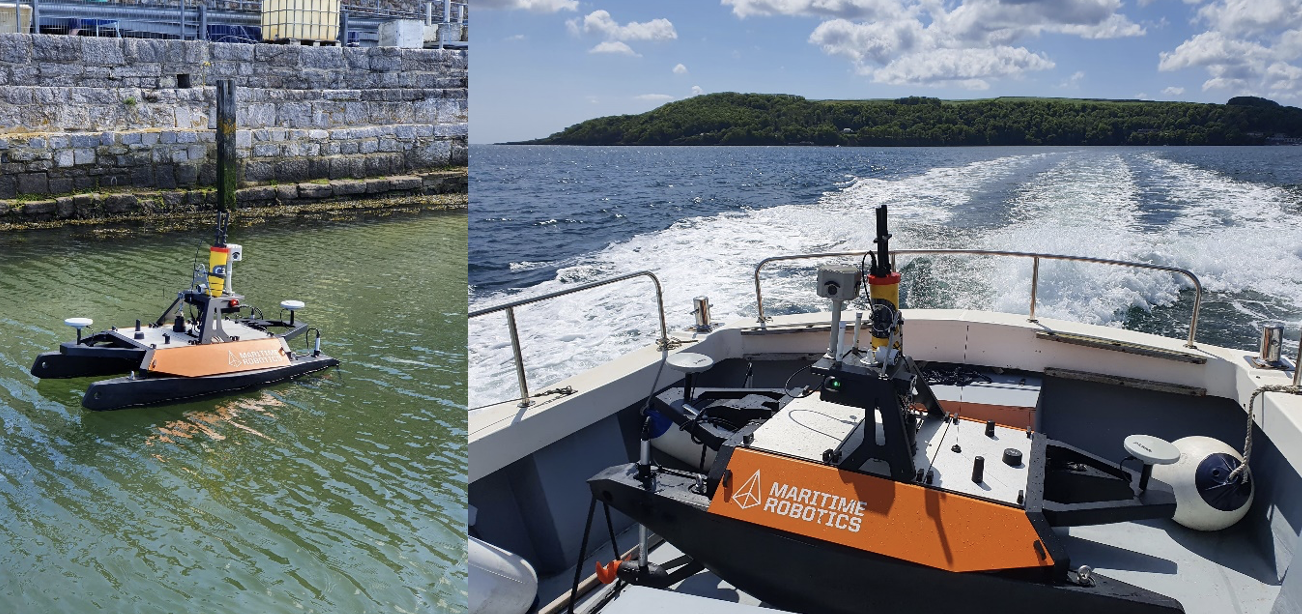
Otter is a Marine Robotics USV that belongs to the Royal Navy. She is effectively a commercial version of Red and Yellow Pigs designed for inshore and estuary survey work. She is primarily used to train hydrographers.
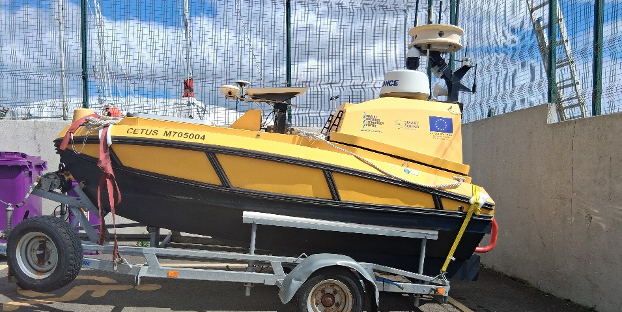
Cetus is a 4.5 m diesel driven aluminium hulled USV with a top speed of seven knots and a maximum endurance of 48 hours. She was manufactured in Portchester by L3 Harris. In the Sound, the university's Cetus has a moonpool in the middle part of her hull (under the Starlink Aerial) and the aft ‘cabin’ hinges at the front edge to open up another space for power systems.
There is also a forward bay for hydrographic/oceanographic sensors to be fitted. Cetus has an extensive communications suite, including Starlink, 4G, Wi-Fi and military-grade radio datalinks.
Finally, Bauza – a 4.75m long L3 Harris ASView fitted C-Enduro class USV, also built in Portchester, belonging to the RN. Her propulsion is a diesel engine charging a DC battery, with two 3 kW electric drives. With a 1 kW solar panel and a 300 W wind turbine, this gives her up to 6 weeks' endurance.
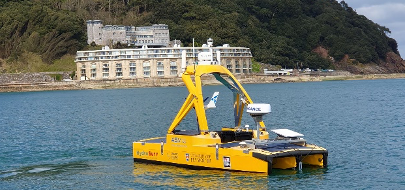
During the Repmus 2024 large-scale annual NATO maritime innovation exercise held off the coast of Portugal, Bauza was controlled from Coxside in Plymouth over Starlink. She was the only one of the USVs involved to have been controlled remotely. Repmus 2026 will feature more than 300 USVs. Airborne drones may get most of the attention because of the war in Ukraine, but the marine area is certainly not being neglected - and Plymouth is the UK’s National Centre for Marine Autonomy!
On the buses

Some may have noticed Civil Enforcement Officers (aka Traffic Wardens) on the City Centre to Seafront No. 25 bus, and other routes, recently. The intention is to catch those who decide to park in bus stops (a more ‘expensive’ offence than just parking on double yellow lines) or otherwise impede the progress of the bus.
When an offender is seen, the bus will stop, the offender’s car will be logged and photographed, and the Civil Enforcement Officer will reboard until the next problem is observed.
It beats walking!
Robbery and assault in The Barbican
Police are appealing for witnesses and relevant footage following a robbery in the Barbican.

Shortly before 11 pm on Saturday 8 August, police were called by the ambulance service reporting a man had been assaulted on Notte Street, suffering a head injury. Officers attended and the victim described how he was approached by a male suspect as he made his way back from an evening out.
When the victim refused to give the suspect money, he was punched several times. The victim then gave the suspect £40 to leave. The suspect is described as a white male, with short black hair, a short black beard, around 5ft 10ins tall and of slim build.
Officers are keen to hear from any witnesses, or anybody with relevant dash-cam or CCTV footage. Anybody who can assist is asked to call 101 or visit the police website quoting 50260210896

- Congratulations to Arts University Plymouth, which has today been named Arts University of the Year. The national award recognises the university’s range of creative courses and professional facilities, inclusive routes into higher education, practitioner-led teaching, responsiveness to industry demand and support for graduates entering the creative industries.
- Despite £3m being spent on mending Sutton Harbour's lock gates and footbridge in 2023 and 2024, they broke again this week (after also breaking last year and being 'repaired'). Environment Agency engineers had to be called in to fix them. MP Luke Pollard said: "It's not good enough. Ever since I was elected, I’ve campaigned to get this footbridge properly fixed, along with the Sutton Harbour lock gates." So how's that turning out, Luke ?
And finally.....
The Hoe featured on the front of the Metro newspaper this week (even though the only way to get a Metro is to find one that has been left on a train from London arriving in Plymouth!)

Advertisement:

Tell us your news:

Comments ()