
History made by Plymouth's Oshen as its autonomous vessel is the first to complete a transatlantic crossing
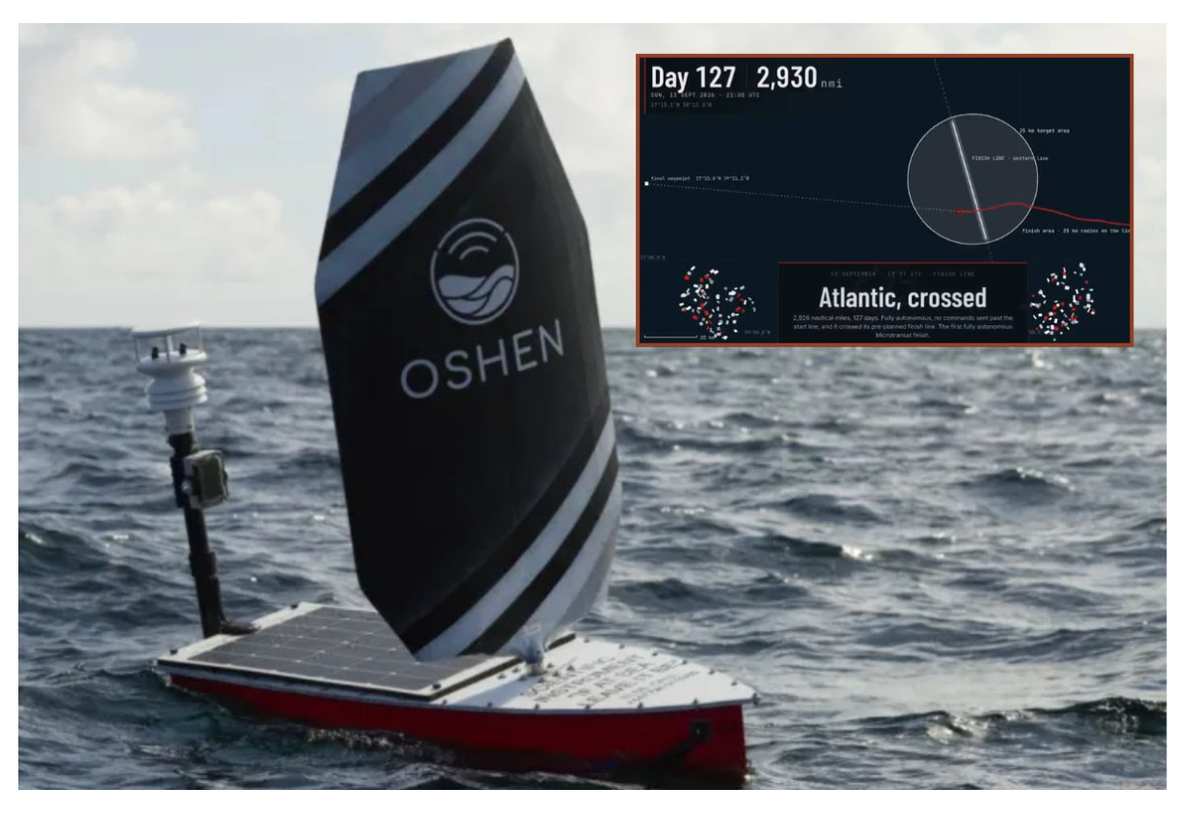
Plymouth-based Oshen’s C-Star small uncrewed surface vessel (USV) has become the first autonomous vessel of its kind to complete a transatlantic crossing.
They win the autonomous vessel ‘Blue Riband’, writes The Captain, Beagle maritime correspondent
Hand-launched from a rhib off the coast of Gran Canaria in the Canary Islands in May, the USV was set the target of sailing to a point almost 2,500 miles away, just off the coast of Barbados.
The rules were exacting - once underway, teams could not control the vessel in any way. The boats had to be no more than 2.4m (7’8") long. This deliberately limited the deck area available for solar panels and therefore the amount of power for onboard systems such as computers and thrusters.
Over 16 years, there have been more than 30 attempts to meet this challenge – including by Shanghai University, France’s Ecole Navale and the US Naval Academy (six times).
Oshen, at their third attempt, is the first to succeed!
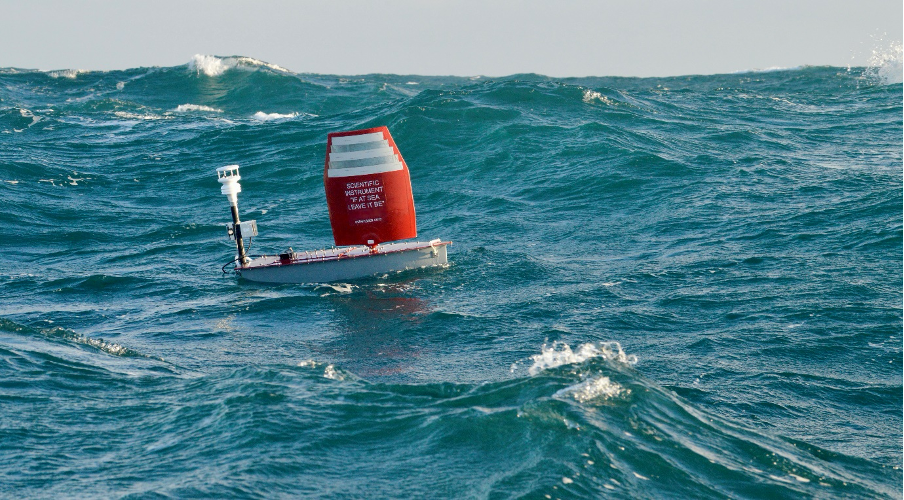
C-Star PC13 crossed the finish line east of Barbados at 9:56 UTC last Sunday (13th September). Over 127 days, she covered 2,926 nautical miles (5,400 km), navigating trade winds and busy shipping lanes to win the Microtransat Challenge – the most difficult and elusive prize in maritime autonomy.
Oshen’s first attempt was in 2023 and it ended after just twenty days and 10km. Two years later, a modified boat set off from Plymouth and sailed for 277 days, getting three quarters of the way across the Atlantic, before losing her sail in heavy seas. Many lessons were learnt from these two attempts and the result is now obvious. As written last week, Oshen has developed its technology to the point where C-Stars are now routinely deployed on long-duration missions in extreme environments.
Whilst C-Star PC13 did not encounter a hurricane during its Atlantic crossing, she did have to sail through Storm Dolly on 28–29 August, around day 113 of the mission and, right up to her arrival in Barbados, the team weren’t certain that she’d make it.
Just three weeks ago, Oshen, based at Turnchapel Wharf, announced a $5 million funding round to expand C-Star production in Plymouth. The company says its workforce has grown from seven people in September 2025 to almost 30, while production capacity has increased from 15 robots in its first three years to 15 every six weeks, with another 100 ordered.
[NB] The Blue Riband is the accolade given to the fastest passenger liner crossing the Atlantic Ocean. It is held by the USS United States and is likely to be so held in perpetuity. Richrd Branson beat the record in Virgin Atlantic Challenger II in 1986, but the Americans refused to give up the trophy on the, not unreasonable, grounds that Virgin Atlantic Challenger II was not a passenger liner.
Farewell to the Guiding Lights
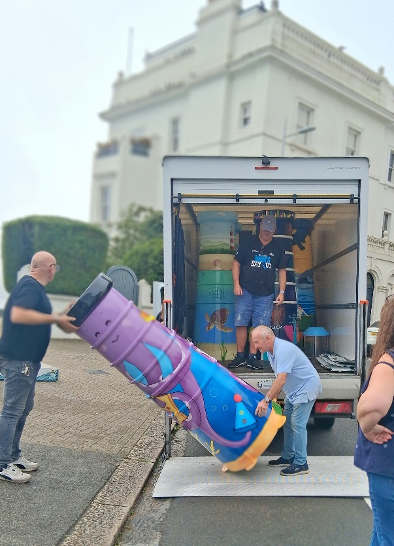
Judging by the number of people following the St Luke’s Guiding Lights lighthouse trail, it must have been one of their most successful campaigns. This week the lighhouses were removed. But all is not over.
All 92 lighthouses, large and small, will be displayed together for one final time at the Guiding Lights Farewell Weekend next weekend, Friday 25 to Sunday 27 September, at Market Hall, in Devonport (PL1 4PS).
It's a chance to see all the painted sculptures, meet some of the artists, and snap up raffle tickets to win the fantastic Night Light sculpture by Lucy Hebden.
And of course, if you’d like a permanent memento of your own, the lighthouses are being auctioned on 1st October – see https://www.stlukes-hospice.org.uk/guiding-lights for details.
The Captain's guide to what the Beagle Editor calls "ship hooters"
If you were around the Sound on Tuesday afternoon, you will have heard five short blasts from the Pont Aven.
So what does this sound signal indicate? Well, first a few definitions.
A ‘short’ blast is about one second, whereas a ‘prolonged’ blast is 4-6 seconds long. You may not be surprised to know that ‘The International Regulations for Preventing Collisions at Sea’, commonly known to sailors as the ‘Rule of the Road’, even lays down what frequency a sound signal should be based on the length of the sounding vessel!
So, in theory, if you hear a loud rumble, it is likely to come from a ship over 200 metres long, whereas a much shriller signal should be a ship (or boat) of under 20 metres.
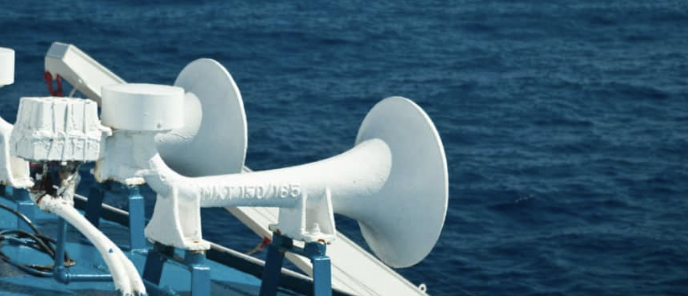
But to get back to the four common sound signals. There are one, two, three and five short blasts. The meanings are:
- One short blast – “I am altering my course to starboard”
- Two short blasts – “I am altering my course to port”
- Three short blasts – “I am operating astern propulsion”.
- Five short blasts means that “one vessel fails to understand the intentions or actions of the other” – in plain sailor-speak “what are you doing? You’re in my way, in danger etc.”
Note that 1-3 indicate future ship movement – so, for example, three short blasts means my engines are going astern – not that I have yet gathered sternway. There may be an appreciable delay before the ship actually starts to slow down, let alone go astern.
So this week, as Pont Aven headed towards the West Hoe through Asia Pass – the shallower channel nearer Drake’s Island that can be used at high water – there was a yacht anchored in Asia Pass.
Pont Aven cannot safely leave this channel and, initially, probably did not realise that this yacht was at anchor (no anchor ball – a subject I’ll cover in a future Scene on the Sound).
A passing tug, the Citadel, ‘explained’ to the yacht’s crew what the problem was and their anchor was hastily raised, whilst Pont Aven ‘hovered’ in the channel. Fortunately there was not a strong wind blowing or Pont Aven might have been in real difficulty – but in those circumstances, she would probably have used the deeper channel - Smeaton’s Pass.
So – if you hear five short blasts – look up and see what’s going on. Someone on the Sound is getting grumpy!
"Noise cameras" for the Hoe and West Hoe?
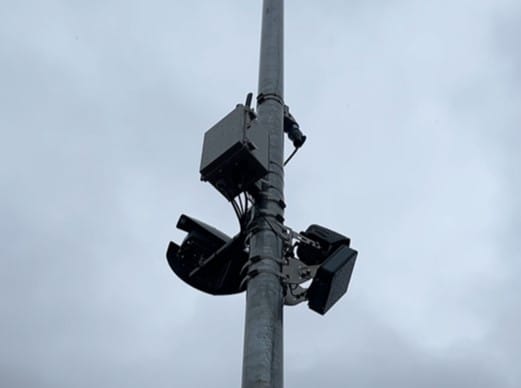
Moves to install "noise cameras" to crack down on anti social driving are being stepped up. Plymouth City Council wants to be among the first in the region to have a ‘vehicle nuisance public protection order’ covering engine revving, racing, wheel spins, convoy cruising and amplified music from vehicles. High-tech cameras fitted with number-plate recognition and audio recording are being considered.
High numbers of complaints have been made to Waterfront councillors about noisy drivers in cars and on motorbikes. Plymouth’s police commander, chief superintendent Alexandra Doughty, recently confirmed that anti social driving was one of her key priorities.
Waterfront councillor Chris Penberthy says Plymouth could be among the first to have a vehicle nuisance public protection order, with fixed penalty notices issued by police and council officers for bad behaviour.
“We have the potential to be innovative and to help the people of Plymouth here. I hope the police and crime commissioner joins up with us,” he told this week's Hoe Neighbourhood Forum, echoing comments he made at a formal Plymouth Council Cabinet meeting.
OldManSailing - following Chichester
The Beagle is following 'OldManSailing' John Passmore as he attempts to sail single-handed from Plymouth to Sydney. As we published John was 300 miles off the coast of Western Sahara, having completed 1829 nautical miles (since August 27) with 12,235 still to go!
Advertisement:

Picture of the week
Someone filled the pool and fountain at San Sebastian Square with bubbles this week. Engineers were soon on hand to fathom how to clear it all up!

Cemcarrier comes calling
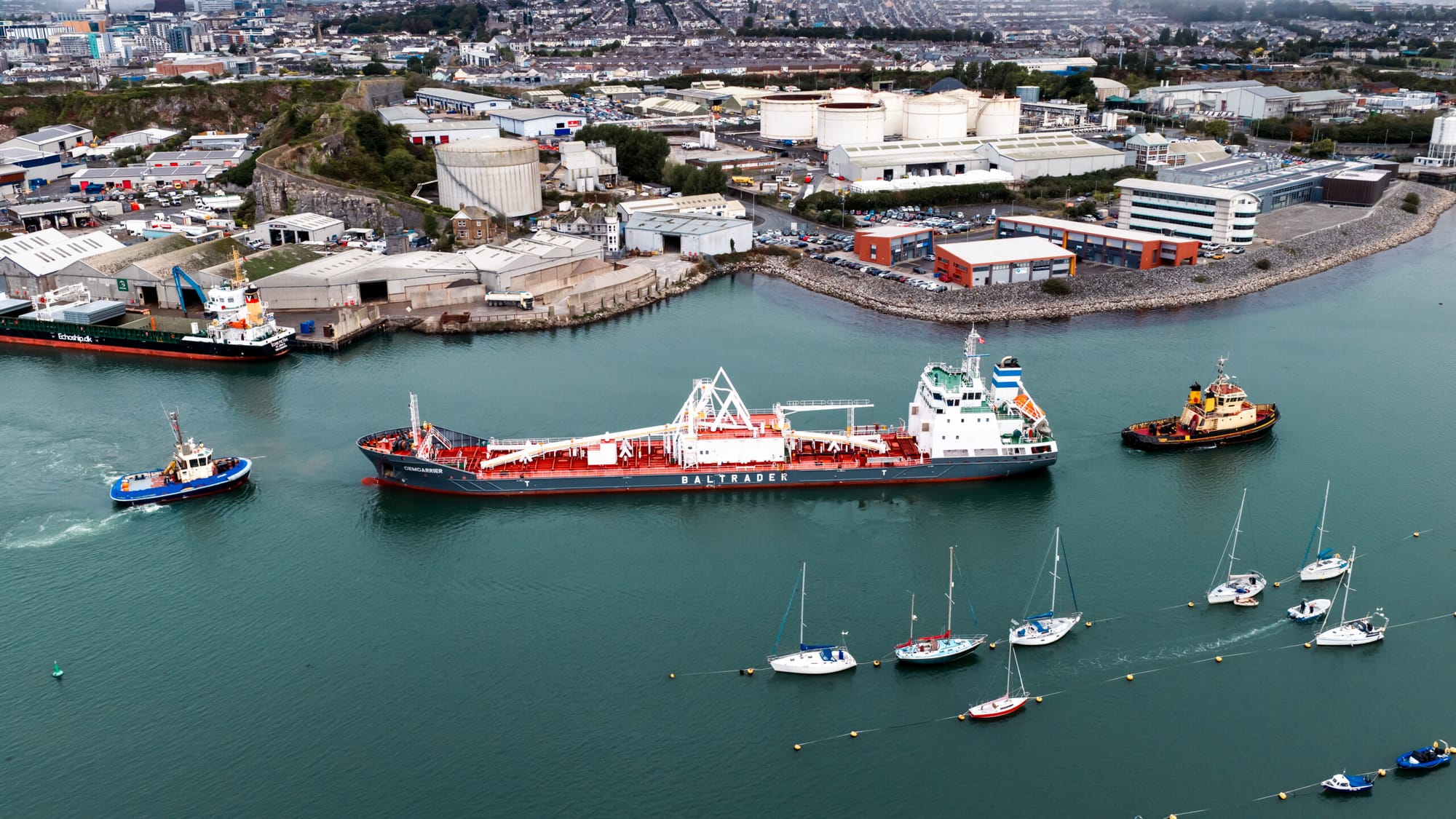
The 113-metre Cemcarrier has made its inaugural Plymouth call and Cattewater Harbour Commissioners says it is the largest vessel ever to berth at Corporation Wharf. It delivered thousands of tonnes of cement intended for housebuilding, roads and other development projects across the region.
Scene on the Sound, by The Captain
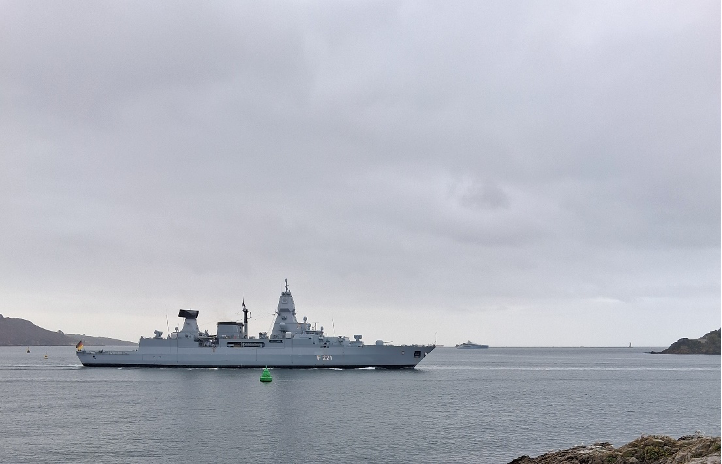
The end of the week saw the arrival of a German ship we haven’t seen here recently – the FGS Hessen – seen here entering port this morning (Friday 18th Sept.). Her sister ship, the FGS Sachsen was here in January and again in July this year for training with FOST’s team. These ships are designated as air-defence frigates and fulfil the same role as the RN’s Type 45 Destroyers, of which one, HMS Duchess is also here under training, so it can be assumed that the two ships will be exercising together at some stage.
Anti-air warfare is one of the most complex areas of naval warfare – with attacking targets that can range from sea-skimming to ballistic missiles (i.e. coming almost vertically downwards) and from slow (drones) to supersonic (up to Mach 5) to hypersonic (above Mach 5) missiles. The intercept geometry is very complex and can only be handled by computers – nevertheless, in most cases, the decision to engage still rests with the Commanding Officer or his delegated Warfare Officer. Controlling one’s own assets is hard enough; co-ordinating with another platform is much more so – for example, it is now possible for one ship’s missiles to be fired against a target that is only held by another ship’s radars.
In the photo above, just to the right of Hessen’s bow, can be seen the superyacht Aviva. She now seems to be ‘based’ here, with the occasional excursion out to Dartmouth or Salcombe. She was at sea for a couple of days this week, but finding out what superyachts are doing or where they are going is more difficult that keeping tabs on naval ship movements! One thing that needs to be done, even by superyachts, is the emptying of their ‘black water’ (aka sewage) tanks. This can only be done when the ship is more than 12 miles from land and making at least four knots.
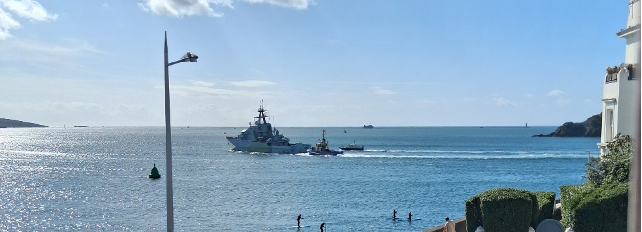
HMS Severn has been here again in the last week – running in and out from the Sound to the Hamoaze – almost certainly conducting advanced navigational training. As has been mentioned before, this is a nerve-wracking time for Commander Brian Drewett, the Captain of HMS Severn, who must allow the trainees to make mistakes, from which hopefully they will learn, but must reassert control of his ship before she actually hits anything.
This Sunday, there will be a charity swim for the Chestnut Appeal from
Firestone Bay to Drake’s Island and return. About 220 swimmers will set off at approximately 1130, and they are all expected to be back at the Bay by 1245. The course will be marked by buoys, and there will be safety craft escorting the
swimmers. As a consequence, all traffic bound between Plymouth Sound and the Hamoaze should route via The Bridge, the channel to the west of Drake’s Island marked by beacons.
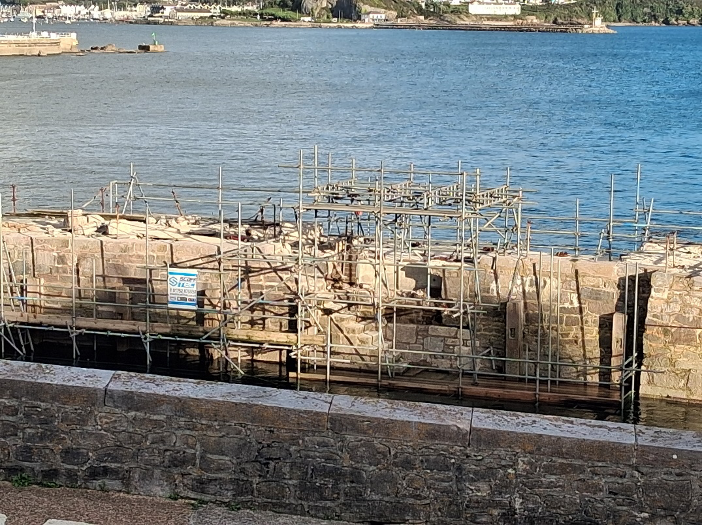
And finally, the good news that the stonemasons have made good progress and, always subject to the weather, they are still hoping to finish the repairs by the end of this month. As can be seen on the photo below (taken on Wednesday afternoon), the area around the harbour steps is looking much more complete.
And finally...... Cosmic Kebabs!
Cosmic Kitchen in Palace Street has made it to the semi-finals of the British Kebab Awards, in the 'Best Vegan Kebab' category. Voting and info here

Comments ()